Yakir Li logo Yakir Li Civilian Bereavement Support (Registered nonprofit) – home page
Yakir Li's flagship program

The Day After Shiva Project

When shiva ends, our connection begins.

Yakir Li's Day After Shiva project works together with local authorities and communities to offer families who have experienced civilian bereavement a personal connection and ongoing support.

Trained local volunteers get in touch with the families, listen to their needs and help in line with their wishes and at a pace that suits them.

Shiva is the seven days of mourning in Jewish tradition, when family and friends gather to comfort the mourners.

You can contact us to receive support for a family, to volunteer, or to run The Day After Shiva program in your local authority.

For families

Contact us by WhatsApp at +972-50-533-5148, by email at info@yakirli.org or through the form. When needed, families can also be referred for financial and legal advice and receive help claiming their rights and benefits.

Home visits

Personal meetings in the family's home.

Phone calls

Staying in touch, even when meeting is too much.

Informal meetings

A conversation, coffee or an outing, depending on what suits the family.

Community commitment

Local volunteers who connect the family to its community.

Meetings take place with the family's consent and at a pace that suits them.

For authorities and communities

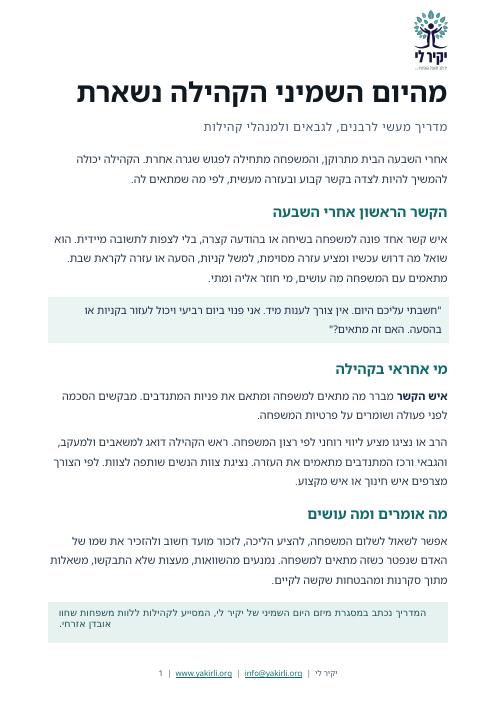
"After Shiva, the Community Remains" is a practical guide for rabbis, gabbais and community managers on how a community can keep standing beside the family after the shiva.

First page of the community guide (Hebrew)
View the guide (PDF, Hebrew)

For volunteers and anyone visiting a house of mourning: A Guide for Comforters

For authorities

Bringing the program to a local authority

  1. 1

    Approaching the local authority

    • Initial contact with the volunteer, social services or community department
    • Presenting the program and checking feasibility
  2. 2

    Approval and coordinating support

    • Briefing meeting with the relevant officials
    • Securing organizational and logistical backing
    • Budgeting the activity (mainly volunteer training)
  3. 3

    Recruiting volunteers

    • Appointing a local volunteer coordinator
    • Recruiting volunteers from the community
    • Volunteer interviews
  4. 4

    Training volunteers

    • Four training sessions led by a facilitator with a master's degree in loss and bereavement
    • Active listening, empathy, support tools, boundaries and referral to professionals
    • Ongoing support and retention of volunteers
  5. 5

    Reaching families who have experienced loss

    • General publicity in the community (notices, flyers, social media)
    • Referrals through the volunteers themselves
  6. 6

    Contact and support for the family

    • Contacting the family for emotional support, a listening ear and practical help
    • A family is contacted only with the approval of the local authority or a social worker
    • Close support from the local authority and Yakir Li, with professional help as needed
  7. 7

    Continuity

    • Retaining volunteers through team-building and enrichment meetings
    • Workshops and training throughout the year
    • A supportive community for the volunteers themselves
    • Involving the family and learning from the field

The key message: a community that stays in touch with families who have experienced loss, after shiva and beyond.

The Day After Shiva branches

Local authorities where The Day After Shiva branches operate.

  • Binyamin Regional Council
  • Eilat
  • Gan Yavne
  • Givat Shmuel
  • Kedumim
  • Menashe Regional Council
  • Netanya
  • Ofakim
  • Rishon LeZion

Bring "The Day After Shiva" to your community or organization

We have a full toolbox. We would be glad to partner with local authorities, organizations and communities to create support for families who have experienced a civilian loss.